
African Diving LTD


We shall not cease from exploration And the end of all our exploring
Will be to arrive where we started And know the place for the first time


Lake Tanganyika is the longest freshwater lake in the world. The lake lies in the Great Rift Valley in East Africa. It is the deepest lake in Africa, meassuring 1470 metres, and the age of the lake is estimated to be 10 million years. Lake Tangnyika is the least accessible of the Great Rift Lakes, with only a few roads leading to its shore.

In Tanzania, on the eastern shore of Lake Tanganyika lies Cape Mpimbwe Establishment. Remote wilderness surrounds the Establishment, and a great variety of wild animals live near by. For 15 years Cape Mpimbwe Establishment has been a centre for dive and fish collecting expeditions on Lake Tanganyika.

African Diving Ltd is a Swedish owned company established in Tanzania in 1988. Export of live fish from Lake Tanganyika and Lake Malawi has been the main activity for several years, and many new fish species have been discovered during the years. New endeavour is the concern of Lake Tanganyika and it's environment.

Cape Mpimbwe at Lake Tanganyika is surrounded by crystal clear water and harbours a great diversity of fish species

Within the borders of Cape Mpimbwe Establishment lies a small area of dense tropical forrest extending to the small beach of Katoba. Here you can find many true sand living fish species in the clear shallow water. Further south the village of Kanchui is located. The wilderness of the vast Utinta Bay starts here. Deep inside Utinta Bay lies a river estuary with a rich wildlife both on land and in water. The swampy area harbours populations of both crocodiles and Hippopotamus.

The remote fishing village of Kashinde is located not far away from the swamp. The village is inhabited only during the fishing season and consists of a dussin grass huts on the beach. Historical landmarks at Utinta Village, on the ridge of Cape Mpimbwe, makes its presence with the old catholic church from around 1895 built on an elevated location with a magnificent view over the bay.

Another historical site near Cape Mpimbwe Establishment is the Belgian mission station at Karema earlier called Fort Leopard that was in the centre of an area ravaged by war and slave-hunting. The station was established in 1879. Within this brick built fortification four or five hundred ransomed slaves and orphans were in residence. Outside were villages of two or three thousand people, who, when the alarm was given, would run quickly for safety to the fort. The fort was handed over to the White Fathers in1885.


Map over Cape Mpimbwe area in Lake Tanganyika

At the tip of Cape Mpimbwe starts the true wilderness with the huge rocks of Mpimbwe point. The abundance of life in the waters of Cape Mpimbwe is overwhelming and it harbours one of the most diverse species of cichlid fish in the lake. More than 100 different species of cichlids live in the rocky habitat and in the sandy regions from Mpimbwe Point in the north to Korongwe in the south. The water is crystal clear during most of the year. Many famous colour varieties hail from this area only, notably Tropheus sp. "Mpimbwe red cheek", Tropheus sp. "Mpimbwe yellow cheek", Ophthalmotilapia nasuta "Black", Ophthalmotilapia ventralis "Silverfrost" and Altolamprologus sp. "Micro" among others. A particular high diversity of Petrochromis species is found at Cape Mpimbwe.

In the water you also find the poisoness water cobra which is frequently encountered during a dive. Other animals like turtles, monitor lizzards and utters are often seen in the waters of Cape Mpimbwe as well. On land many smaller animals and birds are seen. Among the huge boulders near the water lives the beautiful Rainbow Agama lizzards. They are often seen sunbathing on the rocks. A few kilometres off Cape Mpimbwe lies the famous Frontsa Banks. Surrounded by very deep waters, a vast area of submerged lava rocks at 40 -100 metres depth makes a perfect living ground for Cyphotilapia frontsa and other deep living species. The frontosa is encountered in large numbers hovering a couples of metres over the bottom.

Large territorial males are seen among the rocks. The fishes are very curious and often follow the diver in the water. They can also be handfed with fresh sardines. To meet the frontosas in their world is a true experince. Cape Mpimbwe lies at one of the two deep basins of the lake. The greatest depth of the lake, 1470m is located only 40km southwest of Cape Mpimbwe. In close connection to the Cape Mpimbwe Establishment lies the Lwafi Game Reserve and the elusive Katavi National Park. Katavi is a vast million hectare park in the middle of nowhere in Western Tanzania. It is extremely remote and is one of the last great African wildernesses, which utterly thumps with game, the sheer quantity and variety of which is probably unmatched anywhere on the continent.


The serene surroundings of Cape Mpimbwe Establishment.

Lake Tanganyika, which is by far the oldest lake in Africa, has been suggested by J. E. S. Moore to repressent an old Jurassic part of the sea. This idea originated in the discovery of a jelly-fish, gasteropods (snails), and other organisms of a more or less marine type, and presenting some affinity with forms of Jurassic age.

For more than 100 years the Great Rift Lakes have captured the interest of evolutionary biologists. The lakes have produced a great variety of cichlid species which repressent unique examples for the study of speciation and radiation. Lake Tanganyika harbours morphologically, behaviorally and genetically, the most diverse flock of cichlid species.

There are about 200 species scientifically described and many of these species are subdevided into a large variety of distinct populations that vary only in their coloration. The populations' present distribution were shaped by a series of fluctuations of the lake level which caused cycles of isolation and mix-breeding.


Cape Mpimbwe Establishment seen from Utinta Bay

Though rumours of the existence of the lake had previously reached the east coast, Tanganyika was not visited by any European until, in 1858, the famous expedition of Burton and Speke reached the Arab settlement of Ujiji and partially explored the northern portion. Ujiji became famous some years later as the spot where Dr Livingstone was found by Stanley in 1871, after being lost to sight for some time in the centre of the continent.

The 676 km long Lake Tanganyika lies 773 metres above sea level. The lake is unbelievably clear and clean. Visibility under the water reaches more than 20 meters. Over 1500 species of animals and plants have been described from the lake, making it one of the biologically richest lakes on earth. The lake houses incredible species diversity, particularly along its rocky, steep coastlines, where literally hundreds of species of fish and invertebrates may be found at a single locality.

Lake Tanganyika harbours both the worlds largest cichlid species as well as the smallest. Boulengerichromis microlepis grows to about 70cm and the yet to be described Altolamprologus sp. "Micro", endemic to Cape Mpimbwe, does not grow larger than 20mm.


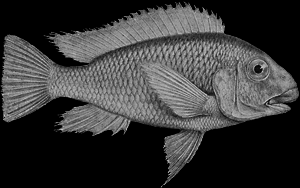
A variety of cichlid fish species from Lake Tanganyika.

February through April are the rainy months for the lake. Water visibility is not at its best during this time. In May after the rain the greenery flourishes and the lake is calm. June through August is windy and has the coolest air temperature.

During this time the lake becomes clearer but occasional algae blooms may occur. September through January is the best time for lake visibility. By then the air temperature is extremely high. The lake is one of the clearest in the world.


Copyright © 1998 - 2004 African Trading AB Sweden. All rights reserved